All times listed are Central Time
Thursday, June 5 (Streetcar Kitchen & Pub, 232 Chestnut Avenue, Carlton, MN)
6:00 – 8:00 pm – Pre-Conference Trivia & Social Event
You’re invited to join us Thursday, June 5 at the Streetcar Kitchen & Pub in Carlton, Minnesota, for our annual Pre-Conference Trivia Contest and Social Event! Test your knowledge and compete against other library folks for The Golden Hockey Puck!
You do NOT need to be registered for LSLS to attend the pre-conference event. All library folks are welcome!
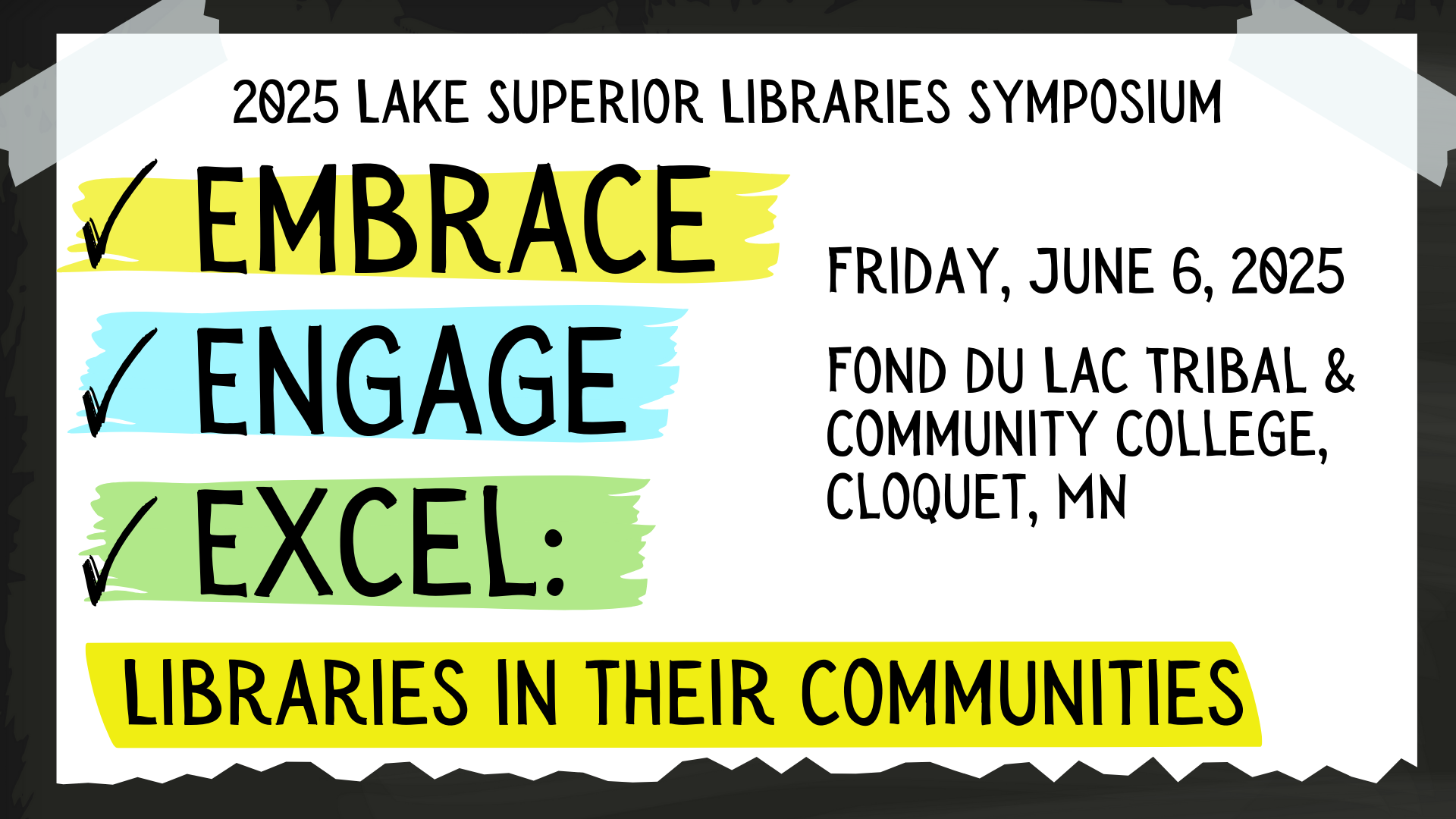
Friday, June 6 (Fond du Lac Tribal & Community College, Cloquet, MN)
8:00 – 9:00 am – Registration & continental breakfast
9:00 – 9:05 am – Opening remarks
9:05 – 10:00 am – Keynote address by Sam Helmick [COMMONS]
10:00 – 10:15 am – Break
10:15 – 11:15 am – Session One
The Patchwork Quilt of Reparative Description: Short History and Modern Projects, Rebecca R. Daly, MLIS (Northern Michigan University) [ROOM 228]
- This presentation will introduce the wide-range of topics that fall under reparative description in cataloging, and will also explore the history of reparative description initiated by pioneering African-American librarians, present projects underway at the Library of Congress and through use of vocabularies. Modernizing gallery, library, archives and special library (GLAMS) records to include accurate tribal names, replacing derogatory terminology, identifying married women as individuals, giving equal respect (and space) in your classification system to all religions and classes of people, all falls under the umbrella of reparative cataloging in description! We will briefly look at best practices in planning and implementation, while we check out a variety of the excellent resources created by fellow GLAMS.
- Presentation slides
- Ideas for Beginning Reparative Description Projects
- Adding Local Fields and Alternative Vocabularies
- Resource Bibliography
Minnesota K-12 School Library Census, Ashley Dress (Southeast Library System), Bethany Kauffman (Prairielands Library Exchange) [ROOM 230]
- In the spring of 2023, the Minnesota Multicounty Multitype Library Systems were provided a one-time $1 million appropriation from the Legislature to conduct a census of school libraries around the state along with other activities. This presentation will discuss the results of the census that was conducted in spring of 2024. The data provides insights on the state of school libraries in MN: how they are doing, what support they need, and what opportunities for growth exist. Attendees will walk away with a better understanding of the K-12 school library landscape in Minnesota and where their own school library may fit within that landscape.
- Presentation slides
All Over the Place: A Review of Research Methods Used to Understand Physical Library Space, Zoey Colglazier, Susan Fiser, Heidi Gunderson, and Patrick Leeport (University of Wisconsin-Madison iSchool) [ROOM 257]
- Libraries evolve to embrace the needs of their communities. These changes frequently address the physical space within the library, and require thoughtful and meticulous planning informed by community usage. The methods libraries have used to collect data relating to library space vary greatly. From small sample qualitative studies through technology used to measure space utilization, libraries have an array of tools to help them better understand space use. This presentation will provide a menu of methods for libraries and their stakeholders to choose from when beginning their own library space assessments. By reviewing the strengths and weaknesses of each data collection technique, attendees will leave with a better understanding of which strategy would be most appropriate for their library and the needs of their communities. Particular attention will be given to methods looking to uplift voices historically marginalized in library spaces. This presentation will be relevant to library workers regardless of whether they are planning for a major renovation or looking to make simple tweaks to library space to better support patrons.
- Presentation slides
Summer Reading Camp, Shelly L. Finzen, (Tyler Public Library [Plum Creek Region]) [ROOM 232]
- Tyler Public Library has hosted a 1-week Summer Reading Camp for the last two summers, with a 3rd summer in the planning stages. The goal of the program is to get kids engaged in summer reading through stories, games, crafts and fun. My presentation will include a description of how I run my camps and walk participants through how to establish their own summer reading camp experience that fits their library/community. We will talk about why summer reading is important, curriculum development, funding/fundraising, and advertising.
- Presentation slides
- Sample summer reading camp (Reading Rainbow)
11:15 am – 12:30 pm – Lunch (Taco buffet)
12:45 – 1:45 pm – Session Two
Recognize, Revisit, (Re)Commit: Deconstructing Silos within the Library through Empowering Staff to Explore, Sara Gliniecki, Syerrah Davunt (University of Minnesota Duluth) [ROOM 257]
- Communication breakdowns between teams and individuals, isolated workflows, and a lack of understanding or commitment to shared organizational goals—the symptoms of a workplace silo, and the warning signs of a system vulnerable to burnout, stagnation, and a disengaged community. Workplace silos create barriers between library staff and the community they serve, by inadvertently creating hoops to jump through. Silos develop in every organization and manifest uniquely based on their environment; breaking down those silos only requires committing to three foundational principles: recognizing, revisiting, and recommitting. These principles provide a framework to forge interdepartmental partnerships, identify areas of potential improvement while celebrating existing strengths, and build strategies to center service outcomes for the library user. Our process begins with identifying shared service outcomes and team strengths, then considers whether or not existing structures are furthering desired outcomes, and finally embraces change or recommitment to existing procedures with a new appreciation for how and why those processes serve us. By interrogating established processes with a collaborative, anti-hierarchical lens, library workers create an opportunity to make changes or recommit to existing procedures with a more holistic understanding of how and why those processes are necessary. This presentation will recount the actions taken within our own library to identify and challenge the effects of siloed departments and workflows, address the iterative process of analyzing and adapting our approach through the ensuing changes, and showcase lessons learned throughout the process.
- Presentation slides
Libraries, History, and Community Services: Life on a Library-Themed Road Trip, Mary Jordan (St. Cloud Technical and Community College) [ROOM 228]
- During the summer of 2024, I drove from San Francisco to New York City along the Lincoln Highway, the first interstate highway in the United States. I visited historical sites, tourist attractions, and all sorts of nature — but the real point of this trip was to visit public libraries! I stopped in at public libraries across thirteen states, asking questions about services and programs, counting displays and books, talking to library people, and taking hundreds of pictures. In the process I found a wide array of fantastic things that libraries are doing! When you are thinking about what kinds of materials and programs and services to offer in a library, it can be so helpful to look at what others are already trying. Join me in admiring a sample of public libraries from across the country, and the wonderful work they are doing.
Shelf Awareness: How Library Skills Sneak into Volunteering, Johnna Horton (PALS [Program for Automated Library Systems]) & Bridget Reistad (most recently of Lake Superior College, now volunteer in Duluth with various literacy and arts groups) [ROOM 230]
- In this session, you will hear how two of your colleagues are applying their library management skills and experience to contribute back to their communities by fostering engagement and encouraging operational efficiency. Libraries have long been hubs of community connection, and the skills developed in managing these institutions—such as organization, resource management, and community outreach—are key in volunteer work. Attendees will learn practical strategies for applying these skills to help build stronger, more connected communities.
- Presentation Slides
- Presentation handout
Exceptional Opportunities, Actual Problems, Practical Solutions: UW-Madison’s iSchool Library Transition as a Driver of Access, Stewardship and Learning, Bronwen Masemann, Megan Adams, Greer Christensen-Gibbons, Celeste Qin (UW-Madison iSchool Library) [ROOM 232]
- The student entering the Wisconsin Library School in Madison in Fall of 1912 was promised in the School’s Catalogue for that year “Exceptional opportunities to come into contact with actual rather than theoretical problems, and to work these problems out to practical solutions.” More than a hundred years later, as the UW-Madison iSchool prepares to move to a new building on the UW-Madison campus in Summer 2025, we reflect on this history and reaffirm our commitment to hands-on learning, information access and collaborative stewardship. This presentation provides a case study of a large-scale collection project, outlining our goals, planning process, and outcomes. We will demonstrate several innovative approaches to data-driven decision making and sustainable project management that could be applied across library settings, using tools such as PyMARC, Tableau, Notion and Google Suite. We will also introduce our audience to distinctive collections at the iSchool relevant to the Great Lakes region, emphasizing our collection of two thousand annual reports and newsletters from public libraries, academic libraries and library schools. Finally, we will provide several ideas for experiential learning in a project of this scale, examining digital humanities classroom collaborations, staff development and training, and student internship experiences throughout the project.
1:45 – 2:00 pm – Break
2:00 – 3:00 pm – Session Three
Empowering Library Professionals: Free Learning for Every Stage of Your Career, Ann Kaste (Minitex) [ROOM 230]
- Join us to explore the exciting developments in the Minnesota Libraries Learning Network (MLLN) and other free, online professional learning opportunities available to our region. This session will provide a bit of background on the MLLN project and how it has been reinvigorated and reimagined by The MLLN Coordinating Council, a group of library leaders from Minitex, State Library Services, MNPALS, MLA, public libraries, academic library education programs, school libraries, academic libraries, and the MCMTs. The Council has come together to plan and create course content that is essential for all library professionals in Minnesota and the northern region. These courses will be available to anyone interested in the workings of libraries to register and work through at no cost, and participants will be able to share transcripts and certificates of their accomplishments with employers and on social platforms. We will review these current efforts and share plans for the future as we strengthen our amazing regional library community to be more inclusive and supportive of all library workers and their professional growth.
- Presentation slides
Creating Inclusive Library Spaces for Older Adults, Brenda Shafer-Pellinen and Ashley Craiglow (Arrowhead Area Agency on Aging) [ROOM 257]
- Join us for an empowering and practical session focused on transforming library services for older adults. This interactive workshop begins with “Pushing Back Against Ageism,” where we’ll examine common stereotypes about aging, how to recognize and counter ageist attitudes, and how to work to make our libraries ones that are welcoming and accessible to people of all ages and abilities. Following this foundation, our panel of library professionals will share successful strategies for creating genuinely age-friendly spaces and services. Learn how to design physical environments that accommodate varying abilities without segregating or stigmatizing older patrons. Discover programming that engages older adults as active contributors rather than passive recipients, honoring their knowledge and experience. The session will highlight effective community partnerships with senior centers, healthcare providers, and advocacy organizations that expand the library’s reach. Panelists will share case studies of low to no-cost innovative programs including technology education, intergenerational initiatives, and creative aging workshops that have successfully engaged diverse older populations.
Efforts to Engage: Responding to the Requests and Needs of American Indian Nations at the University of Minnesota Duluth Archives, Morgan Olson (Tribal Archivist at the Bois Forte Heritage Museum), Dr. Jill Doerfler (Professor and Department Head of American Indian Studies at the University of Minnesota Duluth), Seanna Stinnett (former UMD Archives Intern and staff member and current University of Minnesota Duluth American Indian Studies Administrative Associate and Graduate Programs Coordinator) Aimee Brown, and Percy Calderwood (both University of Minnesota Duluth Archives) [COMMONS]
- In a round table discussion, this session will explore how non-Tribal archives and libraries can take a Tribal Nation-centered approach to working with materials related to Indigenous peoples. Panelists will discuss the importance of relationship building, education, and methods for prioritizing the needs of Tribal Nations as experts and primary beneficiaries. They will also share how the UMD Archives used the “Protocols for Native American Archival Materials” as a jumping off point to develop relationships and collaborate on projects with local Tribal Nations, discussing examples of work they have done so far and how they plan to continue that work. Topics will include an overview of the sovereign American Indian nations within the 1854 Treaty Territory, UMD’s historic relationship with Tribal Nations, and current efforts to improve those relations, the formation and work of the UMD American Indian Archives Advisory Council, and how that work has informed UMD Archives practices and impacted Tribal Nations.
- Presentation slides
- Photo selection
3:00 – 3:15 pm – Break
3:15 – 4:15 pm – Session Four
Farm to Library: Building a Partnership with Your Local Ag Organization, Calla Jarvie (Rock County Community Library) [ROOM 257]
- Every state and nearly every county has a Farm Bureau or a Farmer’s Union. What you may not know about your local agriculture organization is they are an incredible partnership waiting to happen. Attendees will leave this session with examples of extremely successful and low-cost programs our small rural library has done with our local farm bureau, including a petting zoo for children and annual trivia nights for adults. Attendees will also leave with materials to take home to more easily implement what they learn, such as activities from our programs and examples of Ag Trivia questions. Most importantly, attendees will leave with an idea of how to get reach a group of people – farmers – that they many not have been able to before.
- Presentation slides
A Holistic Approach to Library Safety, Jason DeShaw and Kaitlyn Tillman (Duluth Public Library) [ROOM 230]
- Duluth Public Library, like many libraries, has faced enormous challenges in the world of safety and security. Over the past three years, DPL has created a strong system to better support both patrons and staff through difficulties and crises. This includes the addition of two Library Safety Specialists, a dedicated Safety and Security Team, and a peer-support group for staff. Hear from Library Supervisor Jason DeShaw and Library Safety Specialist Kaitlyn Tillman about lessons learned and the challenges ahead.
- Presentation slides
WHAT THE $@!! AM I GETTING MYSELF INTO? A Quick Look into the Process of a Public Library Building Project, John Thompson (IFLS Library System & JT Library Planning) [ROOM 228]
- Undertaking a building a new library or renovation project is often a once in a lifetime adventure. Most librarians have little or no experience navigating the process. This session will provide an overview and visual walk through of a public library building project process starting with assessing the initial needs of the library and community, developing your vision, hiring an architect, and other steps up to going out to bid. The presentation is based on the WHAT THE $@!! AM I GETTING MYSELF INTO? A Library Building and Space Planning Guidebook. While the guidebook is written with smaller communities in mind the process is applicable to public libraries of various sizes. Ample time will be provided for attendees to ask questions. Get a free PDF copy of WHAT THE $@!! AM I GETTING MYSELF INTO? A Library Building and Space Planning Guidebook emailed to you when you complete this form: https://forms.gle/VAKj3zrXKEfGvNoo7
 Lake Superior Libraries Symposium