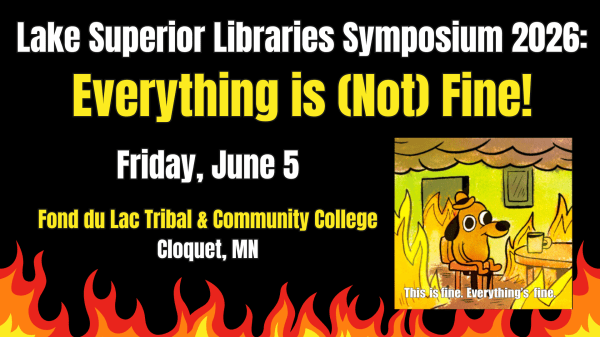
The Lake Superior Libraries Symposium is a regional conference and organization designed to help library staff in the Upper Midwest develop enhanced professional networks and promote resource sharing and communication between organizations.
Our 2026 Symposium was held Friday, June 5 at Fond du Lac Tribal and Community College in Cloquet, Minnesota.
Our 2026 conference theme, “Everything is (Not) Fine!” addressed the unique challenges facing libraries and information professionals, and sought to offer support, solidarity, and solutions to those challenges. From funding cuts to the seemingly-unchecked proliferation of artificial intelligence into nearly every aspect of our lives, the role of an informational professional has never been more challenging — or more important. As information professionals, it is our responsibility to help our patrons and the communities we serve navigate a constantly-evolving and increasingly polarized information landscape, which can be challenging when we’re already expected to do “all the things!” At LSLS 2026, we identified our common challenges and worked together to develop sustainable solutions.
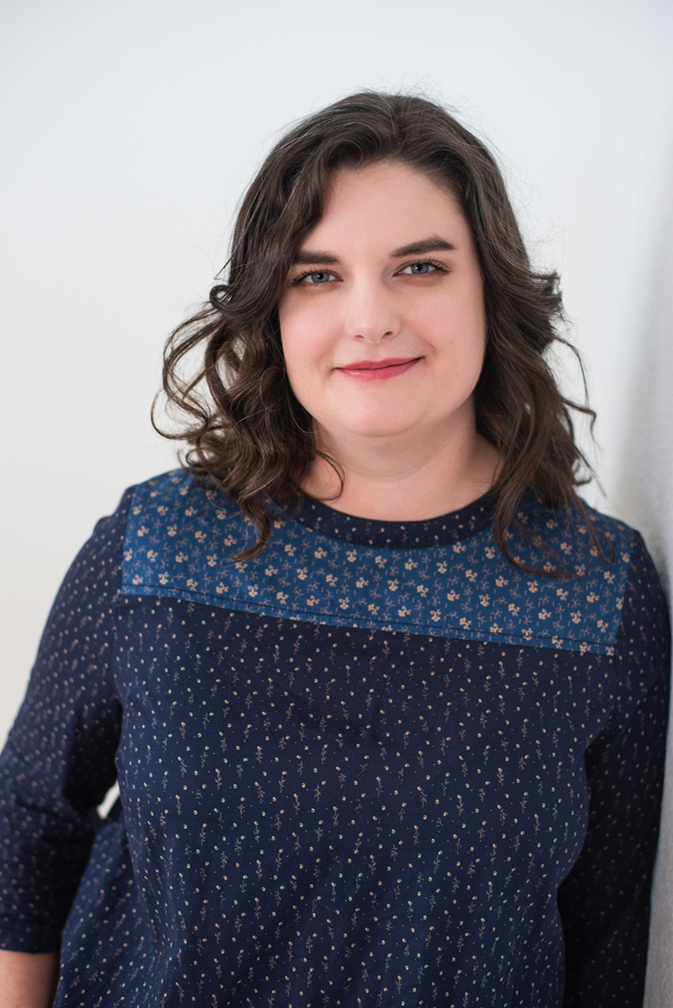
Our 2026 keynote speaker was Dr. Alexis Elder, associate professor and department chair of Philosophy at the University of Minnesota Duluth.
She researches issues in AI ethics, with a focus on the intersection of AI and interpersonal relationships, often drawing on historical traditions to help understand emerging ethical issues. She is the author of Digital Ghosts: Confucian, Mohist, and Zhuangist Perspectives on AI and Death (2025) and Friendship, Robots, and Social Media: False Friends and Second Selves (2018), both published by Routledge, and collaborates with the Kathryn A. Martin Library to support an Information Literacy Community of Practice.
Conference Schedule
8:30 – 9:00 a.m. Check-in/light breakfast
9:00 – 10:00 a.m. Keynote presentation with Dr. Alexis Elder [Commons]
- “Ghosts in the Machines: How eeriness and otherworldliness can help us navigate our current information ecosystem”
- It is hard to avoid being inundated with a flood of information and digital content. In the face of this overwhelm, it is tempting to seek ways to simplify. But the philosopher C. Thi Nguyen cautions against the “seductions of clarity”, in which our desire for inquiry-terminating feelings of clarity and fluency stand in the way of genuine understanding. Instead, he argues, we need ways to gesture roughly at the world, inviting further reflection when we can neither conclusively answer a question nor leave it behind. In a recent New York Times editorial, Katya Ungerman invites us to think of information technologies through the lens of folklore, where interactions with fairies may require us to look for subtle tells of their inhumanity, mythical beings may do exactly what we ask instead of what we want, and time can slip by without our noticing. Doing so can help arm us against the enchantments of a world that is not as it seems, while still empowering us to be clever and careful in our interactions with it, whether we enter or its creatures intrude into our own world. I build on this invitation, connecting lessons from folklore to research on self-radicalization in search technologies, as well as cognitive vulnerabilities that may be exploited in our interactions with large language models. These metaphors can help us navigate the information ecosystem while taking note of dangers in a way that does not foreclose further inquiry.
- Presentation slides
10:15 – 11:15 a.m. Session #1
- “Investing in Staff Well-Being: Duluth Public Library’s Culture and Critical Incident Stress Management Teams” with Byron Johnson and Heidi Harrison from Duluth Public Library [Room 228]
- In the wake of Covid layoffs and increasing safety concerns, the Duluth Public Library invested in its staff through the creation of two peer-to-peer teams—a Culture Team and a Critical Incident Stress Management Team. Each team provides avenues for connection and communication. By giving time, space, and training to the teams, staff have ample opportunities to help facilitate the development of resilience, boost morale, and create a welcoming workplace for all employees. This session will provide background on what these teams look like and how they function, explore the value of communication and connection through a hands-on activity, discuss and brainstorm ways in which the Duluth Public Library example can be adapted to libraries of all sizes, and have ample time for questions and further discussion.
- Presentation slides
- “The Chippewa (River) Runs Through It: Outreach Strategies for Far Flung Academic Buildings” with Anna Zook, Stephannie Regenauer, and Hannah Carlton from McIntyre Library at UW-Eau Claire [Library]
- The footbridge on the University of Wisconsin-Eau Claire campus provides a unique challenge to students. For fine arts and health science students, whose classes largely occur in buildings on the opposite side of the river, getting to the library can prove difficult, particularly in winter months, when the common cries of “bridge face” can be heard echoing across campus. In the fall of 2023, the Arts Librarian at McIntyre Library launched a weekly outreach office hour to engage with students in the arts building on the opposite side of the river, crossing the Mighty Chippewa on a weekly basis — bringing giveaways, activities, and spreading the good word of all things library. Based on the success of those efforts, the Instruction and OER Librarians established a similar model two years later, adapting and tailoring the existing model for students in the College of Health and Human Sciences. Connecting with students outside of the library has proven invaluable to understanding the nature of our students’ research needs, building casual connections with faculty, and developing unexpected expertise about the buildings we visit. Though the concept of librarian outreach in academic buildings is not new, this formula has proven to be successful on a level that other outreach programs have not. Librarians commonly engage with 40+ students each week between the two buildings. Together, the librarians will discuss their proof of concept through sharing their successes, failures, and pivots with examples of favorite activities, meaningful moments, and surprises. Audience members will get practical advice on setting up a similar practice through a series of engaging activities and examples of tailoring outreach content to specific disciplines.
- “Collection Analysis in One Semester: A Student Intern and Librarian Perspective” with Daniela Stein and Bekky Vrabel from Kathryn A. Martin Library at the University of Minnesota Duluth [Room 232]
- Bekky Vrabel, Research Support & Liaison Librarian at the University of Minnesota Duluth, and Dani Stein, University of Minnesota Duluth 2026 graduate, will co-present about their experiences developing and being involved in an internship focused on collection analysis of a specialized topic that aligns with the curriculum for a specific class. Attendees will learn about the process of developing what the internship looked like, as well as a beginner’s perspective on learning how to analyze a collection in an academic library. The presenters will cover topics such as building a foundational understanding of collection development and management, assessing community needs, working with a faculty member, and the process of learning and guiding throughout the internship both as intern and site supervisor. Dani hopes to discuss how she developed her own method for analyzing the collection, and how Bekky and Dani worked together to bring the collection towards a more diverse perspective, while aligning with the topics covered in the class.
- Presentation slides
- “Exploring the Digital Universe with Senior Planet” with Leslie Mehle, Lexi Nevin, & Jen Tanko from Superior Public Library [Room 230]
- Providing device assistance to library patrons can be challenging! In 2025, Superior Public Library partnered with AARP’s Senior Planet program to offer technology programs for older adults in the community. This program will explore how libraries can offer tech help and explain the process for becoming a licensed Senior Planet training site and share tips and tricks for success.
- Presentation slides
- “Managed Chaos: Training Library Assistants Made Easier” with Dory Shaffer from Michigan Technological University [Room 256]
- Part-time library assistants often require larger amounts of training than similar positions in other fields. It can feel impossible to ensure new employees’ training is progressing smoothly—especially in fast-paced, high-turnover environments. We fully redesigned our clunky and complicated training program for student reference assistants using a LibGuide. The guide serves as a launching point for frequently needed information, engaging training modules, and activities that can be completed as time and needs allow by staff who assist with training. Learn how you can adapt this flexible training program to meet your library staffing needs.
- Presentation slides
11:15 – 12:30 p.m. Lunch & networking (self-serve taco buffet)
12:45 – 1:45 p.m. Session #2
- “Watch It Burn🌷Together🌷” with Andi Coffin & Jennifer Chamberlain from WiLS [Room 230]
- Whether the dumpster is spouting fire or sprouting flowers, your library can still be a refuge – for staff as much as for patrons. When you invest in your people, in both tangible and intangible ways, you reduce turnover, ease conflict, and build a resilient organization. And the benefits continue to roll in: supported staff generate great ideas, follow through on them, and bring their whole hearts to the work. But if you want staff to care deeply about the library, the library has to care deeply about them. For more than seven years, the WiLS Staff Development Group has been doing exactly that: working one-on-one with colleagues and coordinating across the organization to ensure every employee feels valued. Yes, we’ve taken on big initiatives like flexible workweeks and expanded benefits. But we’ve also built a rich toolkit of small, easy-to-implement practices that have shaped a culture of trust, respect, and genuine care. These strategies can fit into many organizational contexts, and we hope the spirit behind them sparks renewed energy and engagement among the people who carry your library’s mission forward.
- Presentation slides
- “Feeding the Beast – Managing Digital Collections and Exploring Your Options” with Felicia Fiedler from Great River Regional Library [Room 228]
- Join the conversation on what it is like to manage a digital collection with a never-ending demand and explore the different options available to libraries when it comes to vendors, collection management, and what you can do to adapt your approach to this dynamic collection. This presentation will cover the advantages and disadvantages of different digital collection vendors, discuss priorities when expanding and building a digital collection, what tools are available to libraries to create a sustainable collection, and an opportunity to share current successes and difficulties.
- Presentation slides
- “‘NewNewSchedule-April’: Service Model Stress Test” with Anastasia Hanson from University of Wisconsin-Madison Libraries [Library]
- In February of 2025, at the UW-Madison Libraries the new Access Services Unit officially started after several years of discussion, information gathering, and planning. Fall of 2025 our stress test began. New hires, new staffing model, new communication methods and more. Join us as we explore the challenges we faced and their impacts. Including budget cuts which led to location closures, staffing changes, and required hours reductions within the scope of our unit. As our fondly named ‘NewNewSchedule-April’ professional staff schedule represents, the credit goes to our Access Services staff. Their dedication and flexibility that went into our mid-year, mid-semester hours changes allowed us to meet these changing circumstances. We will look at some of the data that shows the successes of our staffing model. This model has improved our schedule stability, increased support for front line staff, and contributed to consistency of library services across locations. As a unit we have worked hard to define and solidify our values and strategies for maintaining a generous and sustainable staffing model. We are building strong partnerships within the ecosystem of library units and advocating to address needs that have been brewing for years. We will discuss with attendees how this process or structure may apply to individual contexts. While our work is not done, we are looking toward the future and as Access Services to be leaders in the necessary conversations around our spaces, hours, and services. This session reflects the challenges and advocacy to stick to staffing models that are sustainable and humane for staff. Attendees will also examine strategies and lessons for having difficult conversations with staff. Attendees will analyze staffing model stability through scheduling; including primary, backup, and crosstraining for front line staff. Attendees will also examine examples of advocacy for library staff needs.
- “How Prepared Are High School Graduates? First Year Faculty Perspectives on Media and Information Literacy Readiness” with Ann Kaste, Jenny Turner, Stephanie Sparrow, and Jenna Pomraning from Minitex [Room 232]
- This session will share findings from a multi-phase research study conducted in partnership with Minitex and the Multicounty Multiype Library Systems (MCMTs), alongside an advisory team of school and academic librarians. Wilder Research developed an assessment plan and conducted approximately 25 interviews with (non-library) postsecondary faculty who regularly worked with first-year students. Interviews explored faculty perceptions of students’ research strategies, source evaluation skills, use of evidence, and broader media and information literacy competencies. Transcripts were analyzed thematically to identify common strengths, persistent skill gaps, and areas of misalignment between secondary preparation and postsecondary expectations. Findings were synthesized into a policy brief and informed a review of existing student assessment instruments. The research team created a crosswalk aligning assessment items to ITEM standards and developed a pilot student assessment to measure competencies most relevant to first-year academic work. Participants will consider how these findings can inform first-year library instruction, faculty collaboration, legislative advocacy for media specialists in all schools, and the promotion of media literacy instruction in K–12 education.
- Presentation slides
2:00 – 3:00 p.m. Session #3
- “Party in the Garden: Weeding and Sustaining an Aging Print Collection” with Nichole Chisholm, Ian Moore, and Katie MacDonald from Kathryn A. Martin Library at the University of Minnesota Duluth [Room 232]
- What should you do when your shelves become too crowded? What if your library users are finding things so outdated and strange that you can only laugh incredulously? Well, you put on your hat and gloves and prepare to get dirty! Like any flower bed or vegetable garden, library collections require ongoing cultivation. In order to maintain a relevant and accessible collection, we must be willing to weed materials that no longer serve our users. This presentation will provide best practices for maintaining a robust collection while efficiently using limited space. Join representatives from a medium-sized academic library at a regional state university as we walk through the many steps involved in managing a physical collection. We will discuss our collection management policy, retention commitments, deselection criteria, workflow tracking, evaluation methods, and the process of withdrawing and responsibly disposing of materials. Attendees will have the opportunity to review materials and evaluate them for currency, condition, and the potential for harm to members of a library’s community.
- Presentation slides
- “Walk the Vote: Centering the Library as a Campus Civic Engagement Hub” with Helena Sumbulla and Anna Zook from the University of Wisconsin – Eau Claire [Room 230]
- In our age of rising authoritarianism, academic campuses are frequently scrutinized for political actions and activity by federal and state government entities. Students seeking trustworthy information about voting report finding nonpartisan and credible sources increasingly difficult given the polarized and partisan information landscape. McIntyre Library in Eau Claire, WI has been filling the voting information gap on our campus through voting LibGuides, social media campaigns, tabling, and nonpartisan handouts about candidates and referendums. In 2023, staff and librarians established a Civic Engagement Team to educate our students about voting rights – including inviting local non-partisan voter registration groups to register students to vote, creating a digitally accessible flowchart for in-state and out-of-state voters, and emphasizing the forms of identification students need to successfully cast their ballots. Attendees can expect to hear about logistical challenges, working with campus leadership, outreach efforts, and assessment techniques the team uses to measure the impact of this work – walking away with tools and ideas to implement similar measures in their library. Examples of the LibGuide, flowchart, and handouts will be provided.
- “Library Collection Policy: Banned Books and What We Learned” with Kate Rolfe, Suzy Cervin, Ann Kaste & Quinn Krebsbach from Erickson Library, Lake Superior College [Room 228]
- Inspired by news of a banned book case, this prompted us to reflect on our own circumstances and recognize that we lacked a collection policy addressing potential challenges. In this session, we’ll share the steps we’ve taken—and continue to take—to safeguard our collections. We will also share resources from the Minnesota Library Association’s Intellectual Freedom Committee about what you can do before, during, and after a challenge occurs. We’d also love to hear from the audience on what’s working well and what may need updating for your libraries.
- Presentation slides
- “A Doctor, A Nurse, and a Custodian Walk into a Library” with Anna Robbins, Alee Hill, Renee Lamoureux, and Diane Wennberg from Essentia Health [Room 256]
- In a world where health information is everywhere, medical librarians are helping health professionals sort through the noise to find accurate, up-to-date, evidence-based information. This panel from the Essentia Health Medical Library will take attendees inside the “day in the life” of a medical librarian, offering a look at the work happening behind the scenes and the impact it has on clinical decision making, patient education, and community health. Panelists will share examples of how they support physicians, nurses, pharmacists, and other health professionals by searching databases, locating trusted resources, and answering complex questions quickly and accurately. They will also highlight tools, databases, and search strategies that public and academic librarians can use when helping patrons navigate online health information. In addition, the panel will explore non-clinical support services such as well-being resources and respite activities, including ideas that can be adapted in any library setting to help support library staff and strengthen workplace culture. Attendees will leave with a better understanding of the role of medical librarians and new tools for guiding patrons toward reliable health information. Just as important, they’ll come away with ideas for supporting the well-being of their own library teams in a time when “everything is not fine” for many information professionals.
- Presentation slides
- “Whose Job is it Anyway? The Role of Libraries in AI Literacy” with Emma Schmidtke and Jenny Turner from Minnesota State University, Mankato [Library]
- From addressing machine-generated misinformation at the reference desk to tracking down fabricated citations to navigating AI-powered search engines, library workers from across sectors are called upon to engage with, reject, or embrace AI in a variety of ways. What is often missing from these conversations is a robust consideration of how AI interacts with library workers’ established values and responsibilities. This breakout session will explore libraries’ roles in relation to AI, define professional boundaries, and identify opportunities for promoting greater information literacy. Emma Schmidtke and Jenny Turner of MNSU-Mankato will present how they have connected AI literacy instruction to their existing roles as information literacy educators. They will share resources that have shaped their thinking on AI literacy and facilitate conversation among participants about their experiences with AI tools and information as well as their perspectives on library workers’ responsibilities in the current age. Participants will learn how to advocate for their professional roles and values in conversations around AI and proceed with greater confidence in promoting AI and information literacy in the modern information landscape.
- Presentation slides
- Handout
3:15 – 4:15 p.m. Session #4
- “Escaping the Doldrums of Orientation” with Samantha Wolf, Syerrah Davunt, and Eugenia Ortega Martinez from Kathryn A. Martin Library at the University of Minnesota Duluth [Room 230]
- In Spring 2025, the Library Events Committee was approached by the Bulldog Resource Center regarding summer orientation. They wanted to try something new called “orientation excursions,” or an activity during the single-day orientation that had nothing to do with academics or finding locations on campus. The Events Committee was asked if the library would be willing to host an escape room. Join us for a dive into the challenges and triumphs that surrounded this project, from managing expectations across multiple campus units, designing the entirety of the puzzles in the room from scratch, sourcing props and designing the feel of a room, to running them multiple times over the course of the summer. We’ve learned a lot, and are coming back better than ever in 2026!
- “Everything, Everywhere, All at Once: a 360 degree tour of the resource sharing ecosystem” with Gerri Moeller from Minitex [Room 228]
- A few short years ago, the resource sharing environment felt stagnant. Little had changed, systems remained static, and processes were well-established. Today, that landscape has shifted radically. A surge of new systems, including RapidILL, Rapido, ReShare, OpenRS, FulFILLment, the IDS Project, and OCLC Resource Sharing for Groups, has transformed how we connect. This session offers a broad, high-level whirlwind tour of the nature of interlibrary loan in 2026. We will explore the evolving friction between physical and digital collections, with a specific look at the persistent challenges of ebooks. We will discuss the emerging legislative paths and proposed state bills that offer new hope for libraries seeking sustainable digital lending models. Finally, we will address the critical intersection of service and compliance: how do libraries meet the urgent requirements of ADA Title II and universal accessibility while maintaining the seamless delivery patrons expect? Join us for a 360-degree view of an industry in motion, where everything is changing everywhere, all at once.
- Presentation slides
- “Live Well Leave Well: End of Life Planning at Your Library” with Sophia Anderson from Virginia Public Library (Arrowhead Library System) [Room 232]
- Explore how to better prepare your patrons for the final stages of their lives. This session will use Virginia Public Library’s Live Well Leave Well series as a case study to guide attendees through the process of creating their own end of life planning programs at their libraries. Attendees will learn how to find potential program topics, how to find relevant resources for their patrons, and how to identify potential community partners to help guide their patrons in planning for the final stages of their lives.
- Presentation slides
- “Signs Point to Browsability: Developing Subject Signage for an Academic Collection” with Natalie Holmes, Kate Conerton, and Chelsey Miller from Kathryn A. Martin Library at the University of Minnesota Duluth [Room 256]
- Staff at an academic library created new end cap signage to support browsability of our main collection and demystify LC classifications. The cataloger, a subject librarian, and the marketing and communications person will share their roles in the project.
- Presentation slides
For just $70, you’ll experience:
- a keynote presentation by Dr. Alexis Elder, associate professor and department chair of Philosophy at the University of Minnesota Duluth
- 18 inspiring presentations that will inspire you to embrace and engage your communities!
- Social networking during a catered taco bar lunch!
- A Thursday evening pre-conference trivia and social event at the Streetcar Kitchen & Pub (232 Chestnut Avenue) in Carlton, MN at 6 p.m.!
Register by May 26 to ensure that any dietary requests can be accommodated.
The Symposium will take place in-person with registration opening at 8:00 am and the last session concluding at 4:15 pm at the Fond du Lac Tribal & Community College campus in Cloquet, MN.
LOCATION & ACCOMMODATIONS
Our conference is located in beautiful Cloquet, which has small town hospitality and is adjacent to the scenic St. Louis River. The region features plenty of outdoor activities for enthusiasts and art murals throughout town at local businesses. Find local accommodations and activities at Visit Cloquet Minnesota.

